The brief
How can viewpoint, colour and paint surface transform familiar objects?
Use drawing as practical investigation to apply painting conventions to an arrangement of your own objects. Build knowledge by making: drawing includes painted studies, colour studies and collage as well as pencil work. Focus on choosing methods for a particular visual purpose.
Materials & preparation
Objects, sketchbook, drawing media, collage paper made from your own marks, acrylic or gouache, prepared study supports and a limited set of brushes.
Use your own drawings and photographs as starting points. Record sources and seek permission for people, places and culturally significant material. Discuss tikanga and context with your teacher where relevant.
Suggested size & quantity
Use these ranges to plan your studio time and materials with your teacher. They are classroom suggestions, not NZQA minimums, maximums or grade requirements. Adapt them to your idea, working pace and access needs.
Practical studies
Aim for about 8–12 studies in total: 6–8 A6–A5 observation, colour, surface or spatial tests, followed by 2–4 more sustained A4 painted drawings. Compare alternatives using your own subject.
Workbook
Allow about 6–8 A3 pages, or 12–16 A4 pages, to hold the studies, a focused comparison of artist methods and brief selection notes. Several small trials can share one page; these are the same studies, not an extra set.
Larger work
An A3 application study can replace a smaller sustained study if scale helps demonstrate your chosen conventions. A separate exhibition-size final painting is not needed for this suggested programme; the practical work should show informed application.
One workbook page means one side of a sheet; a two-page spread counts as two pages. A3 is 297 × 420 mm, A4 is 210 × 297 mm, A5 is 148 × 210 mm and A6 is 105 × 148 mm. Two A4 pages offer about the same area as one A3 page for planning; this does not change any external submission format. Mount small studies or use clear photographs of separate works rather than making everything twice.
Artist connections
Choose the connections that serve your intention. The contemporary models offer different approaches; select a relevant comparison rather than studying every artist. These works are references, not assessment exemplars.
Compare flat colour, compressed figure relationships and densely organised garden space. Select conventions for a particular pictorial purpose in your own observed subject.
Ayesha Green
Contemporary Māori · Aotearoa New Zealand
Green’s flattened colour and still-life subjects open questions about representation, whenua and national identity. Read the context before comparing how an object can carry a public story and a personal association.
McCahon House · Still Life education resource (PDF) · Painting investigation
Kushana Bush
Contemporary · Aotearoa New Zealand
Bush’s gouache paintings organise figures, gestures and intricate detail within a flattened picture plane. Investigate how relationships between people and the repetition of forms can suggest a narrative.
QAGOMA · artist profile and collection · Painting investigation
Jadé Fadojutimi
Contemporary · United Kingdom
Look closely at the colour relationships, layered marks and shifting forms in Fadojutimi’s paintings, then watch Tate’s studio film. Consider how everyday experiences and personal interests can become starting points for abstract painting.
Artist’s official website · paintings · Painting investigation
Paul Cézanne
France
Study the tilted table, overlapping forms and repeated touches of colour in The Basket of Apples. Investigate how a stable object can sit inside an unsettled picture space.
Google Arts & Culture · The Basket of Apples
Historical comparison
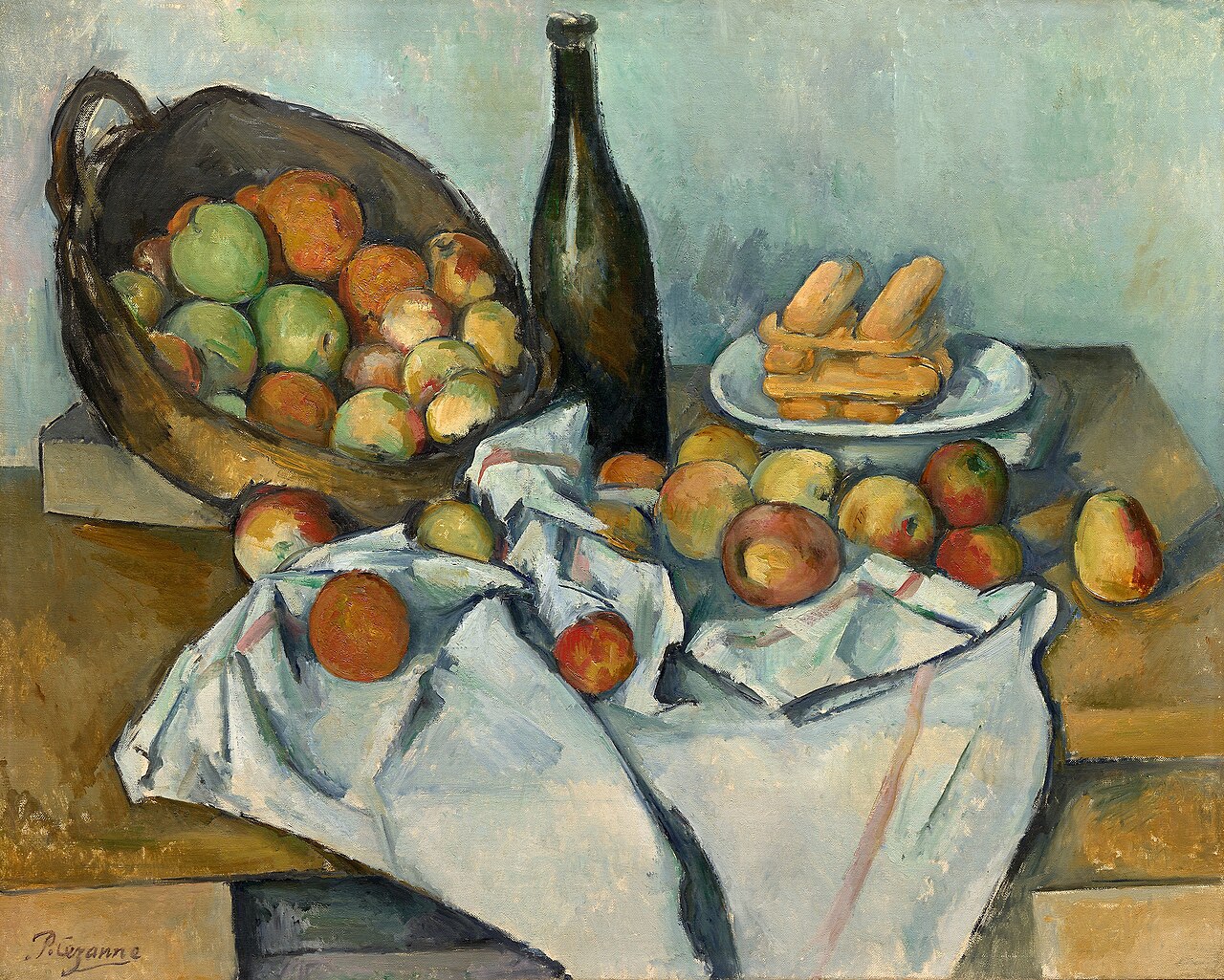

Artwork reproduction rights and assessment permission are different. A reusable image on this site is not automatically suitable for your assessed portfolio. Read the external conditions.
Studio sequence
Use this as a flexible route through the learning. Let the work suggest the next move.
Observe a changing arrangement
Set up a small still life from objects you can draw directly. Record different viewpoints and overlaps. Identify a pictorial purpose, such as making the arrangement feel unstable, intimate or monumental.
Identify usable conventions
Investigate two artist models. Identify particular spatial, colour and surface conventions, then test their effects with your own arrangement. Label the source and the convention, not just the artist’s name.
Make comparative drawing studies
Keep the subject related while changing a deliberate variable: compressed depth versus open depth, warm versus cool modelling, or thin versus opaque paint. Compare the pictorial consequences.
Select for a purpose
Choose the methods best suited to your intention. Develop more sustained painted drawings that apply those choices together. Where a method fights your purpose, revise or reject it.
Review the application
Lay out the studies so your selection and use of conventions are visible. Explain one successful technical decision and one change. The practical work should demonstrate the knowledge without relying on a long essay.
A useful studio conversation
Put two related works side by side. Describe what changed, show the evidence and explain what you will investigate next. Invite feedback, then make your own decision.
Evidence checklist
Use this to review your work. Completing the list does not guarantee a grade.
0 of 3 evidence checks complete
Presentation & submission
Your teacher will confirm the assessment window, support available, final evidence and local authenticity procedures. This sheet is an original teaching resource; it is not an NZQA-issued assessment. Compare NZQA’s annotated exemplars.
What changes between grades?
Student-friendly guidance adapted from the standard. The whole body of relevant evidence determines the grade; the examples below illustrate possibilities.
| Grade | What the evidence needs to show |
|---|---|
| Achievement | Apply relevant painting processes and pictorial conventions in practical work.In this task: Studies use colour, space or surface conventions appropriately. |
| Merit | Select and apply particular conventions for an intended purpose.In this task: A chosen palette and spatial structure directly support the intended atmosphere. |
| Excellence | Make critical selections and apply an in-depth knowledge of conventions.In this task: You compare alternatives and combine appropriate methods convincingly for the intended effect. |
Authority: NZQA AS91311 achievement criteria and explanatory notes (PDF).
Watch for
Copying an artist image can conceal whether you can select conventions for your own purpose.
Pause & reflect
Choose two studies. Why is one combination of methods better suited to your intention? Explain using visible features.
These optional working notes belong to you. This website does not submit assessment evidence.
Notes and checkboxes can be saved in this browser. On a shared device, clear them before leaving.
Teacher notes
Teacher access
Enter the teacher password to open teaching notes and lesson plans.
Teacher access is unlocked for this tab.
Planning, assessment & differentiation
Assess applied knowledge in the drawings, not the quantity of research writing. Confirm local conditions and authenticity procedures, and moderate against the 91311 exemplars. The focus is the selection and application of conventions; a separate series-development task belongs to 2.3.
Support and stretch
For teaching practice, reduce the number of simultaneous choices, model one material process and invite oral discussion alongside drawing. Offer vocabulary prompts and accessible media. To extend the learning, ask students to compare alternatives, justify a rejection or investigate a consequence of their own decision. Adapt assessed support to the standard’s conditions and any approved arrangements.
Before issuing the task
Set local start and finish dates, agree available materials and check the current standard, conditions and exemplars. Use school authenticity processes and your normal moderation procedures. Adjust this brief to the class and context; it has not been quality assured by NZQA.
Assessment window:
Teacher / class:
Checkpoint dates:
NZQA sources for this sheet
- AS91311 · official achievement standard (PDF)
- NZQA exemplars and assessment resources
- Visual Arts National Moderator’s Report
Checked 22 November 2026. This original task sheet interprets NZQA requirements for a painting classroom; official NZQA documents govern assessment.